Ifyou’ve ever sourced a product across multiple suppliers—machining with Vendor A, surface finishing with Vendor B, testing with Vendor C—you already know the pattern: each vendor may be capable, each quote may look reasonable, and yet the program still drifts. Lead times slip, updates get messy, and what began as a cost-saving move turns into expediting, rework, and missed delivery windows.
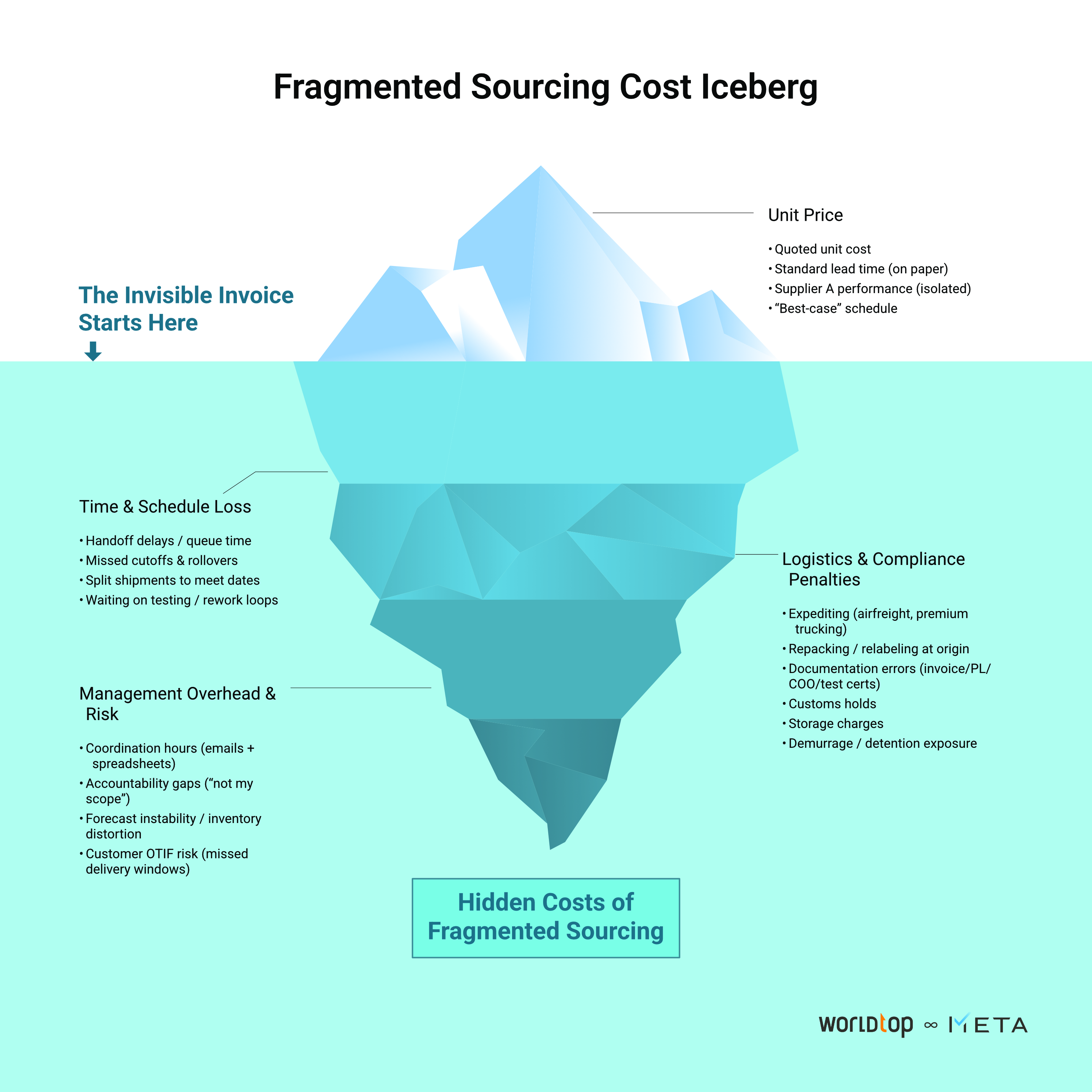
From a logistics perspective, fragmented sourcing doesn’t just create inconvenience. It creates handoff risk—and logistics is where that risk becomes a measurable bill: split shipments, missed cutoffs, storage charges, customs holds,demurrage/ detention exposure, and ultimately, customer trust erosion.This is the “invisible invoice” procurement teams rarely see inthe unit price.
Fragmented sourcing is the practice of splitting a single part orprogram’s process chain across multiple suppliers—CNC machiningat one shop, heat treatment at a specialist, coating at another vendor, testing through a lab, and final packaging at a separate facility. It’s common for understandable reasons: you’re chasing best-in-class capability, comparing unit costs, diversifying supply,or working within legacy vendor networks. On paper, it can look like smart procurement.
The challenge is that each additional supplier introduces a handoff—a point where information, responsibility, schedule, and quality control must transfer cleanly. In today’s environment of tight timelines, frequent design revisions, volatile transport capacity, and stricter compliance requirements, those handoffs are where plans break. The more handoffs you have, the morevariability you inherit—and variability is what collapses reliability.
Unit price is visible. Execution cost often isn’t. Below the waterline is where fragmented sourcing creates its realimpact—especially once freight is booked, cutoffs are approaching, and customers are expecting confirmed ETAs.
Fragmented sourcing adds “quiet time” between process steps—waiting for pickups, queue time at the next vendor, confirmation loops, and small reschedules that rarely appear on a Gantt chart. Those minutes and days compound across multiple transitions, and by the time freight is being planned you’re nolonger protecting the original ship window—you’re trying torecover it. In logistics terms, drift shows up as missed consolidation windows, missed cutoffs, rollovers, and rebookings that can turn a minor upstream slip into a full-cycle delay.
Every additional vendor increases the odds that critical details fragment: revision control, tolerances, finishing specs, labeling, packaging, inspection criteria, or even Incoterms and delivery terms. Individually these errors look small, but they tend to surfacelate—when parts are staged, bookings are made, and schedules aretight. The logistics impact is immediate: repacking or relabeling atorigin, document corrections, last-minute confirmations, and sometimes rework that forces the shipment plan to be rebuilt fromscratch.
When a multi-vendor chain slips, recovery often becomes reactive: ship partial quantities, split the order, upgrade to air, premium-truck the gap, or courier documents and samples. The unit cost may still look controlled, but the total delivered cost spikes through repeated handling, multiple departures, and duplicated clearance events. Over time, this “expedite culture” hardwires unpredictability into the operation—because the plan is no longer built for flow, it’s built for rescue.
With more parties touching a part, variation and defect risk increase, and many failures only become visible at final inspection,testing, or fit checks. When something fails late, the work doesn’t simply pause; it often loops back to an earlier step at a different supplier with a different schedule and capacity reality. From alogistics stand point, late-stage quality surprises create storage while waiting for rework, rebooking fees, unstable ETAs, and missed delivery windows that are difficult to explain—and even harder to prevent without end-to-end ownership.
Fragmented sourcing scatters work-in-progress across multiple sites, producing “almost-ready” inventory that can’t ship because one process step—or one document—is missing. Teams end up managing partial completions, chasing readiness across vendors, and moving goods multiple times instead of once. The logistics consequence is more touches, more warehousing time, more partial shipments, and more cash trapped in WIP—while the business stillfaces the same customer promise dates.
When the process chain spans multiple suppliers, paperwork becomes distributed: invoices and packing lists are assembled from fragments, certificates are issued by different parties, and country-of-originor process provenance can become unclear—especially when finishing, testing, and packing happen in separate facilities. These issues often surface at the worst moment: right before export or during clearance. The logistics impact is predictable—customs holds, document rework, delayed release, storage charges, and higher exposure to demurrage/ detention when cargo sits while compliance gapsare resolved.
Fragmentation diffuses responsibility, so when a deadline slips ora defect appears, the root cause bounces across suppliers rather than being owned end-to-end. Procurement becomes the coordinator, engineering becomes the interpreter, and logistics becomes themess enger of bad news—while the actual execution issues repeat program after program. Operationally, this turns supply chain management into continuous firefighting: more meetings, more escalations, more exceptions, and a system that stays variable because no single party is accountable for delivering a fully shippable, compliant product on time.
In logistics, reliability comes from flow—a predictable sequence of readiness, documentation completeness, and booking discipline. Fragmented sourcing breaks flow in three consistent ways. First, consolidation collapses: when suppliers finish at different times, shipments split, costs rise, and planning becomes reactive. Second, cutoffs become a constant threat: transport doesn’t wait, and missing a cutoff can cost an entire cycle—especially on fixed weekly sailings or capacity-constrained lanes. Third, variability becomes the real enemy: the biggest hidden cost is not always freight spend, but the loss of predictability—missed delivery promises, unstable production scheduling, and disrupted cash flow forecasting. From our vantage point as logistics professionals, fragmentation is less a procurement tactic and more a supply chain risk multiplier.
If you’re unsure whether fragmented sourcing is costing youmaterially, look for these red flags:
A simple way to quantify the tax is to track:
If these numbers are rising, it’s rarely a transport problem.It’s usually an execution model problem.
In today’s fast-paced environment, the goal is not simply “more vendors.” It’s orchestration—a sourcing approach that reduces handoffs and increases end-to-end ownership. The strongest execution models share three traits: fewer handoffs across the process chain, earlier visibility into risk and documentation readiness, and clear accountability for delivering a shippable, compliant product on schedule. This is the difference between buying disconnected services and running an integrated plan.
TradeXchange is designed for teams that need to move beyond manual, siloed sourcing and toward faster, more reliable supplier decisions.
In practical terms, it helps organizations:
The objective is simple: fewer handoffs, fewer surprises, better delivery performance.
If your supply chain feels unpredictable, fragmented sourcing is often one of the root causes. Each handoff adds variability—and variability is what turns ordinary operations into repeated firefighting.
The fastest path to lower total cost and higher reliability is notalways negotiating a better unit price. It’s reducing the invisible invoice: handoffs, misalignment, and late-stage surprises.
If you’d like to quantify your “fragmentation tax,” we can map one of your current part/process chains and identify the handoffs creating the most delay and expediting risk. From there, a TradeXchange walkthrough can show how to reduce fragmentation andi mprove sourcing certainty.
Request a TradeXchange walkthrough using one of your real sourcing scenarios.