TL;DR
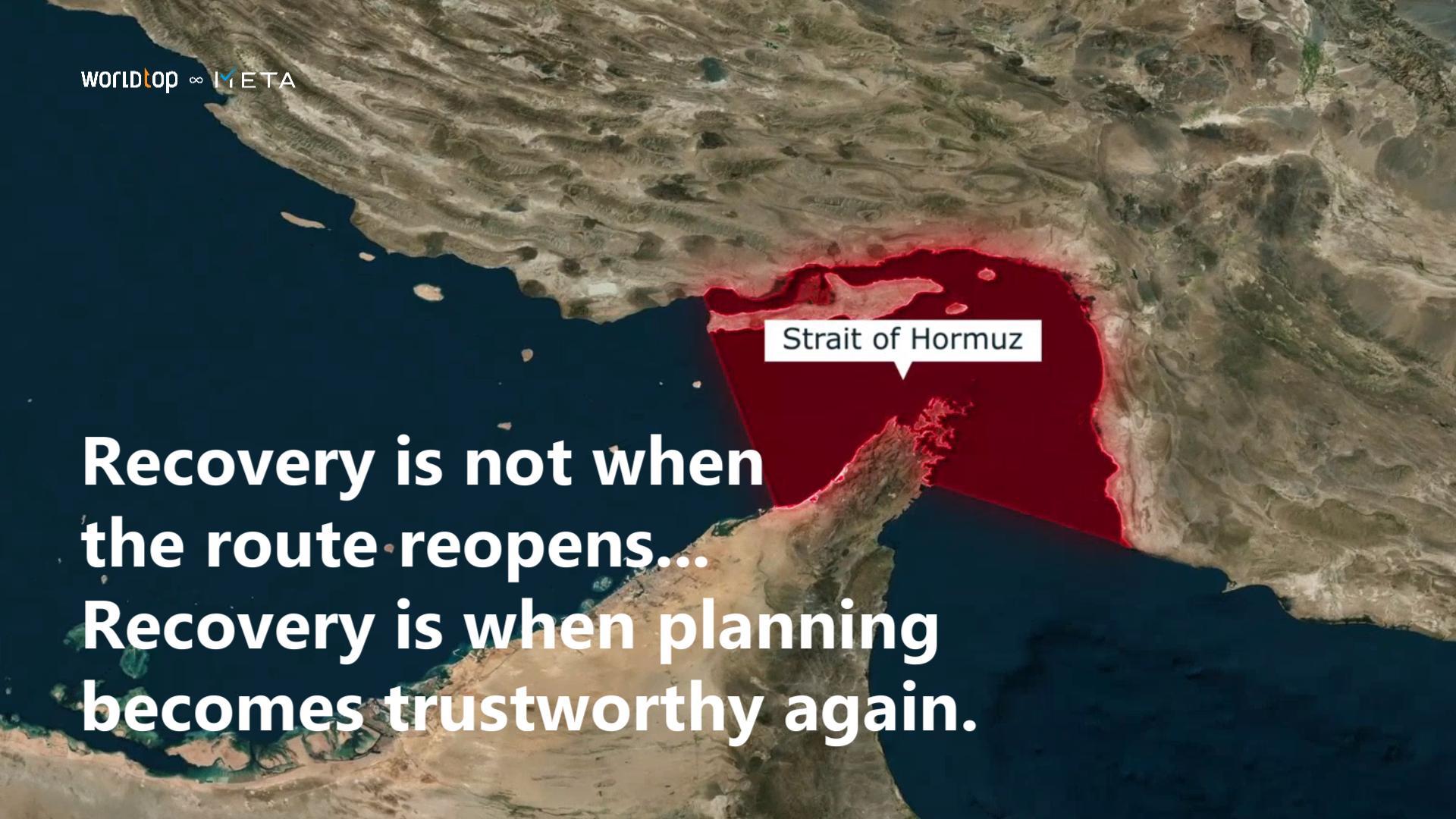
A waterway can reopen before the supply chain recovers. Even if passage resumes through the Strait of Hormuz, importers and shippers may still face delayed vessel positioning, elevated insurance and fuel costs, unstable schedules, rerouted cargo, and customer-service pressure. The real issue is not whether ships can pass on one day. Itis whether the logistics system has regained predictability.
In logistics, “open” and “normal” are not interchangeable.
A strait can be technically open while the supply chain around it remains unstable. Carriers may still be cautious. Insurers may still be repricing risk. Vessel schedules may still be out of position. Shippers may still be working through cargo delays, emergency routings, and customer commitments made under older assumptions. Reuters reported on April 20 that even if the Strait of Hormuz reopens, flows through the waterway could take months, and possibly years, to return to pre-war levels. (Reuters)
That distinction matters because many companies plan as soon as a head line improves. But operational recovery usually lags behind political or military signals. A restored transit window does not immediately restore carrier confidence, schedule integrity, or landed-cost visibility. That is why a reopening can be the beginning of the next planning problem, not the end of the last one. (Reuters)
The first pain point is usually schedule reliability.
When a major corridor is disrupted, the immediate question is whether cargo can move. The more expensive question comes later: whether cargo can move predictably enough for procurement, production, replenishment, and customer-service teams to plan around it. Reuters reported that some freight is already moving on unusual routes, including cargo traveling from Asia to Europe via Los Angeles. It also reported that air cargo capacity to the Middle East had shrunk by more than 50% year on year over two weeks, while long-term Vietnam-to-Europe air rates had nearly doubled. (Reuters)
The second pain point is cost visibility.
When risk rises, cost changes do not stay neatly inside one line item. Fuel prices, emergency surcharges, security-related expenses, insurance premiums, transshipment costs, and buffer inventory need scan all move at once. The IMF has already flagged higher maritime insurance costs and longer shipping routes as part of the shock now moving through the regional and global logistics system. (IMF)
The third pain point is customer promise accuracy.
When schedule integrity weakens, the service issue shifts from transportation to trust. Sales teams may still be quoting old transit assumptions. Procurement teams may still be timing orders to historical replenishment cycles. Operations teams may still be expecting alternate gateways to absorb overflow smoothly. That is often where the real commercial damage begins.
The most common mistake after a chokepoint disruption is to treat resumed passage as proof that risk has passed.
That is too narrow. The more important question is whether the wider network has stabilized. Are vessels repositioned? Are insurers comfortable? Have air and ocean alternatives stopped behaving abnormally? Are importers seeing better booking reliability, or are they simply paying more to keep cargo moving?
Reuters’ reporting on continuing rerouting, high air cargo rates, and persistent ocean gridlock suggests that the market is still adjusting, not normalizing. That means companies that remove contingencies too early may expose themselves twice: first to the original disruption, and then to the aftereffects of assuming recovery too soon. (Reuters)
The best response is not panic. It is disciplined review.
First, this is the time to test whether contingency routings should remain in place longer than originally planned. The existence of an open passage does not automatically make the primary route dependable again.
Second, companies should revisit customer-facing lead times and internal replenishment assumptions. If transit reliability is still uneven, promise dates that were reasonable in calmer conditions may no longer be realistic.
Third, teams should recalculate exposure to fuel, insurance, and mode-shift costs. Some cargo categories may still justify air freight, but others may need a different service design, a different inventory buffer, or a different replenishment rhythm.
Fourth, this is the moment to review supplier concentration as well as route concentration. A company that depends on a single exposed origin, a single transshipment pattern, or a single risky corridor may be discovering that transport resilience and sourcing resilience are not separate questions.
Fifth, resilience should also mean reducing the risk of relying on only one supplier. Businesses should have multiple qualified supplier options, so that when one source becomes disrupted, they are not left with only one path forward. Greater supplier choice does not just improve flexibility. It also strengthens continuity, negotiation leverage, and long-term supply chain stability.
In the short term, the effect is volatility: uncertain schedules, unstable pricing, tighter capacity, and harder customer communication.
In the mid term, the risk shifts into planning. Inventory timing becomes less precise. Working capital comes under pressure. Procurement teams have to place orders earlier or hold more buffer. Service failures become more likely not because teams ignored the disruption, but because they assumed recovery would happen faster than it can operationally happen.
In the long term, the lesson is structural. Companies will need to think more seriously about route resilience, service design, and supplier diversification backed by evidence rather than urgency. A supply chain is not resilient because it can survive one disruption. It is resilient because it can recover planning stability after the disruption without defaulting to guesswork.
The signal that matters most is not the headline that says the corridor is open.
The better signal is the return of predictability: steadier sailings, more normal insurance behavior, fewer emergency workarounds, less rate distortion, and better confidence in replenishment timing. Until those conditions return, reopening should be treated as a positive development, but not as proof of recovery.
For importers, exporters, and supply chain leaders, that is the practical takeaway. A reopened strait may reduce one layer of disruption. It does not erase the operational consequences already set in motion.